
Telescope and spectropolarimeter
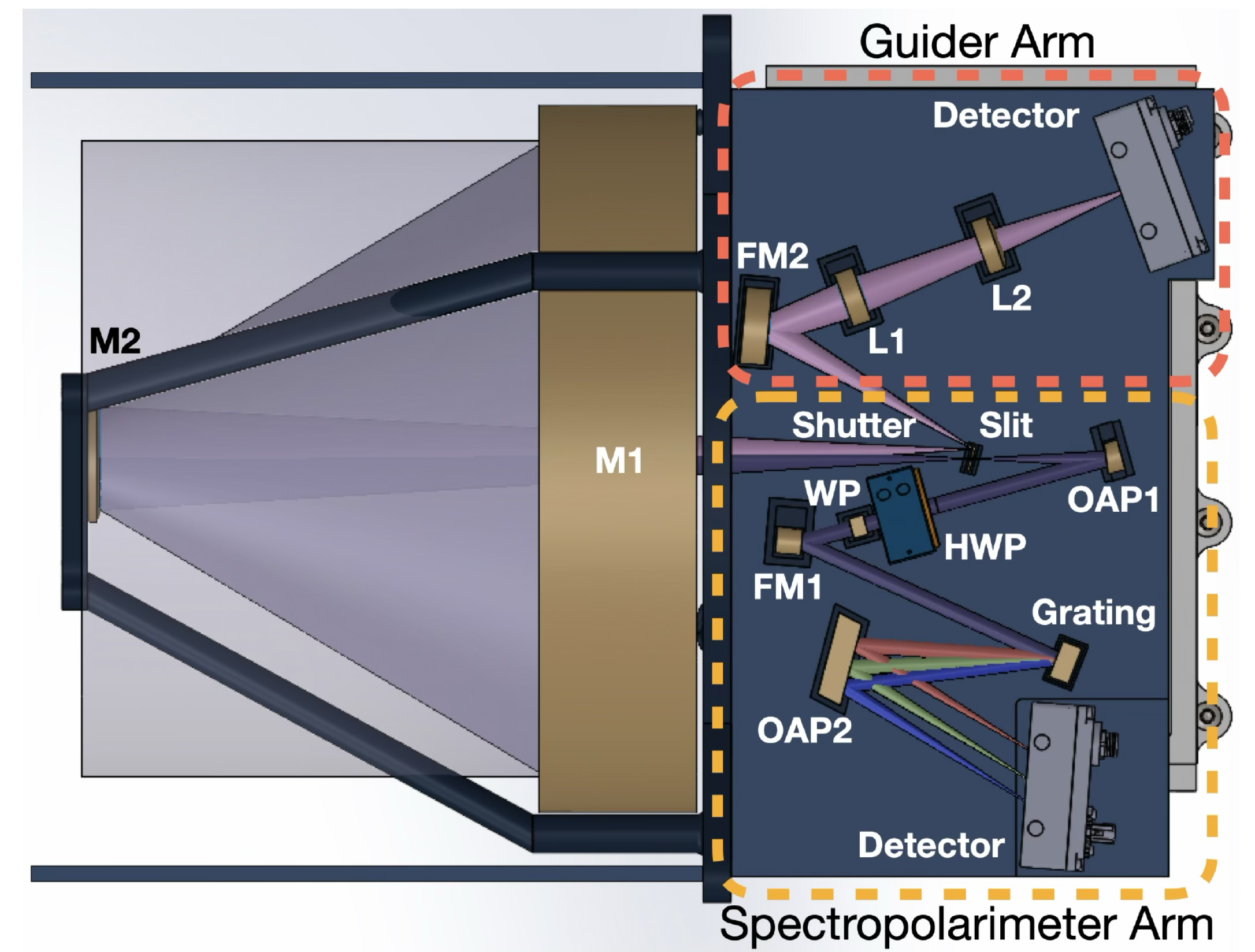
The driving science requirement for PUFFINS is to measure a polarization fraction of 0.2% with an error of 0.02% at 2175 Å. The optical design avoids reflections with large angles of incidence prior to the polarimeter optics to minimize errors due to instrumental polarization.
Design choices
The choice of a protective aluminum coating (Al+MgF2) on all mirrors, UV-sensitive scintillator coating on the detector, and a high/optimized grating efficiency provide an average throughput of 11.5% for unpolarized light. All the subsystems of PUFFINS have been selected to be equal to or greater than Technology Readiness Level 6 (TRL6). PUFFINS builds on the heritage of WUPPE93 using an MgF2 Wollaston and rotating halfwave MgF2 retarder.
Spectropolarimeter and guider
The light from the target star is focused on the spectrograph slit, which functions as a field stop for the spectropolarimeter arm. The slit mask is tilted to reflect the off-axis stars to a visible wavelength imaging guide camera will feed back to the spacecraft bus at a 1Hz cadence. The PUFFINS instrument design includes a payload-integrated guider to deliver 1.5” (1σ) pointing stability and 2.75” (1σ) pointing accuracy.
Detector
Science and guide cameras use the same CMOS sensor with 3.76 µm pixels, read noise under 1.5 e⁻ and low dark current, in an integrated sensor-and-computer package with flight heritage. The science sensor carries a scintillator coating that converts incoming UV photons down to visible wavelengths, where quantum efficiency is high — around 40% across the band.
Calibration
The effective area curve for PUFFINS calculated by multiplying the light-collecting area of the M1 (considering the obscuration from the secondary mirror (M2) and the spider structure) with the Al+MgF2 reflectivity (6 reflecting surfaces),the projected grating efficiency from Horiba J-Y (averaged for both the polarizations ∼ 55-60%), and the detector quantum efficiency with the UV-sensitive scintillator coating. The spectral resolution that can be achieved considering all terms from the optical performance budget is shown demonstrating sufficient margin between the requirements and the expected instrument performance.

| Instrumental polarization | < 0.1% |
|---|---|
| Linear-to-circular crosstalk | 0.02% |
| Average throughput | 11.5% (unpolarized light) |
| Mirror reflectivity | > 85% (Al + MgF₂) |
| Grating | 1300 lines/mm, −1 order, > 60% efficieny |
| Spatial resolution | 5.4″ (1σ, total) |
| Spectral resolution | 150 at 1800 Å |
| Technology readiness | All subsystems ≥ TRL 6 |
Values from the instrument paper, Anche et al. 2025. arXiv:2509.02994

What that adds up to
For a representative target — a B3 star at V = 10.5 — PUFFINS reaches the required polarimetric signal-to-noise on a 0.2% signal in about 66 hours of integration. Across the full target list, the survey closes in roughly eight months.