Super-Serkowski polarization in the UV
Investigate the nature and extent of small grain alignment by measuring SuSeP at wavelengths below 3200 Å.

PUFFINS, a 25 cm telescope feeding a spectropolarimeter, will advance our understanding of the characteristics and dynamics of interstellar dust grains, how they interact with their environment, and probe magnetic fields.
Animation: NASA. Specks of space dust drift past in this illustration
The interstellar medium (ISM) is a dynamic, multi-phased environment consisting of dust, gas, and cosmic rays permeated by radiation and magnetic fields. Stars are formed from the ISM and interact with and replenish it through stellar radiation, winds, and mass loss. The dust in the ISM provides a source of extinction, shielding complex molecules from dissociation and a cooling mechanism for molecular clouds. While of critical importance in the evolution of the universe, the dust composition, evolution, and dynamics are still not fully understood, especially in regard to the smallest grains. Ultraviolet (UV) polarimetry provides a unique tool to probe the characteristics, dynamics, and evolution of small grain populations through its sensitivity to grain mineralogy, size, and environmental parameters.
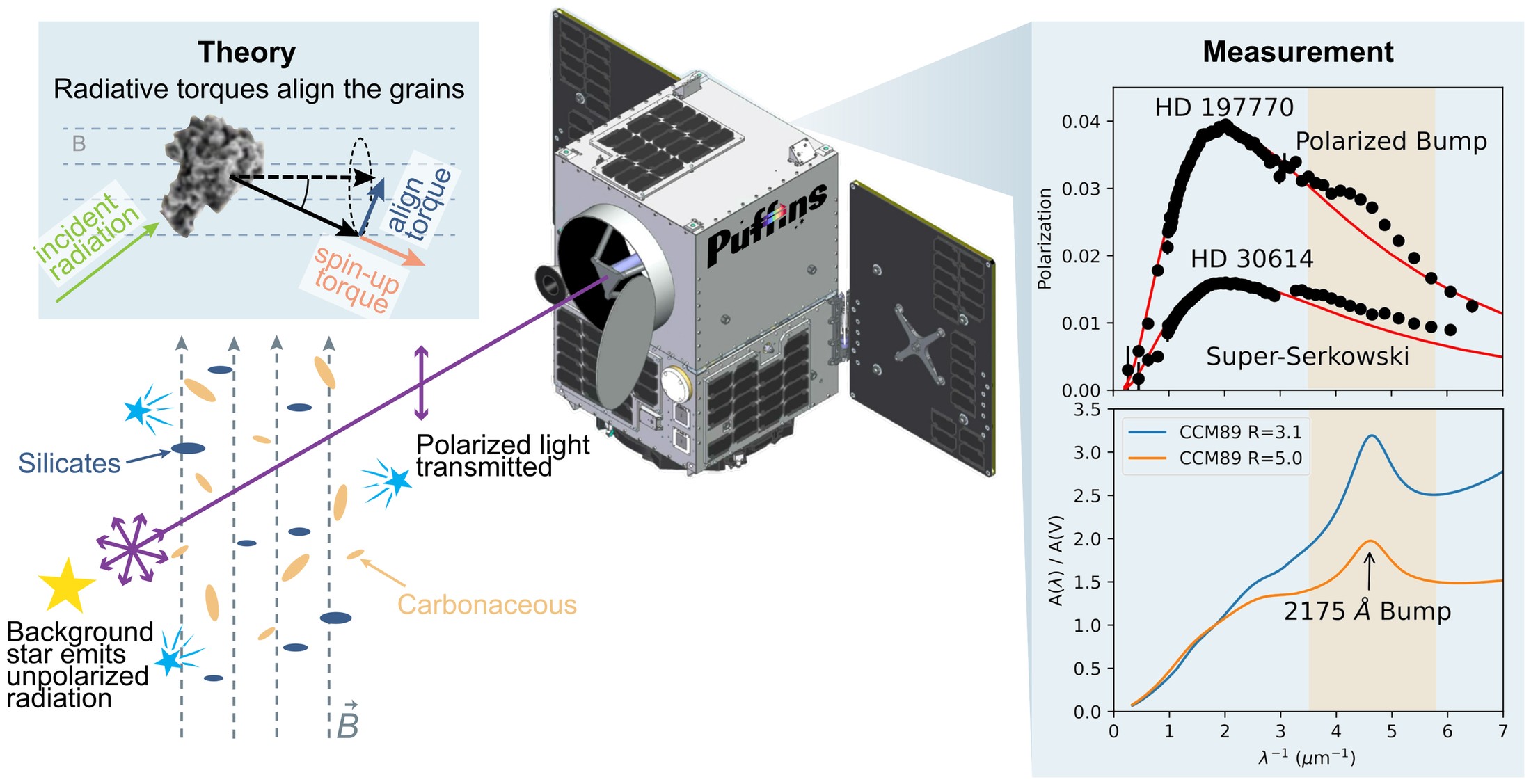
Investigate the nature and extent of small grain alignment by measuring SuSeP at wavelengths below 3200 Å.
Determine the origin and prevalence of the polarization in the 2175 Å feature.
Survey ISM UV polarization along a substantial number of lines of sight with varying extinction, metallicity, depletion levels, and ISM and radiation field characteristics.
The program funds compelling astrophysics investigations on small platforms and gives early- and mid-career researchers the chance to lead a mission.
The mission’s requirements and concept of operations are reviewed end to end at SRR.
The detailed design review before the payload build
🚀
We welcome collaboration on target selection, ground-based supporting spectropolarimetry, and grain-alignment modelling. Students/Postdocs interested in working on UV instrumentation can get in touch with either PI, Deputy PI or Science PI.